
Case study
Seabo – Maritime Chartering & Logistics Web-App
Last updated:
From circular emails to a negotiated chartering agreement.
Shipbrokers traditionally receive offers as circular emails: dense, abbreviated descriptions of cargo and available vessels. Seabo turns that specialist language into structured data and connects it to planning, comparison and negotiation. My work made this complex domain usable through a coherent interface.
Redesigning a platform while keeping it moving
From July 2021 to July 2026, I worked four days a week with a team of five to ten developers. I redesigned much of the platform UI, implemented frontends and contributed some backend work. Alongside new features, I maintained and modernised a large existing codebase shaped by three previous engineering teams.
Connecting an offer to a fixture
The core journey starts with a circular. Brokers test cargo offers against their own fleet or available vessel offers, compare routes and calculate factors such as Time Charter Equivalent (TCE) and CO₂. The interface needed to keep those decisions understandable across several views. Shared design-system patterns helped connect the different tools.
I also introduced the negotiation workflow, enabling users to build, negotiate and finalise contracts end to end. The result is a fixture: an agreement on what will be delivered, where and when. This connected the early assessment of an unstructured offer to the agreement at the end of the funnel.
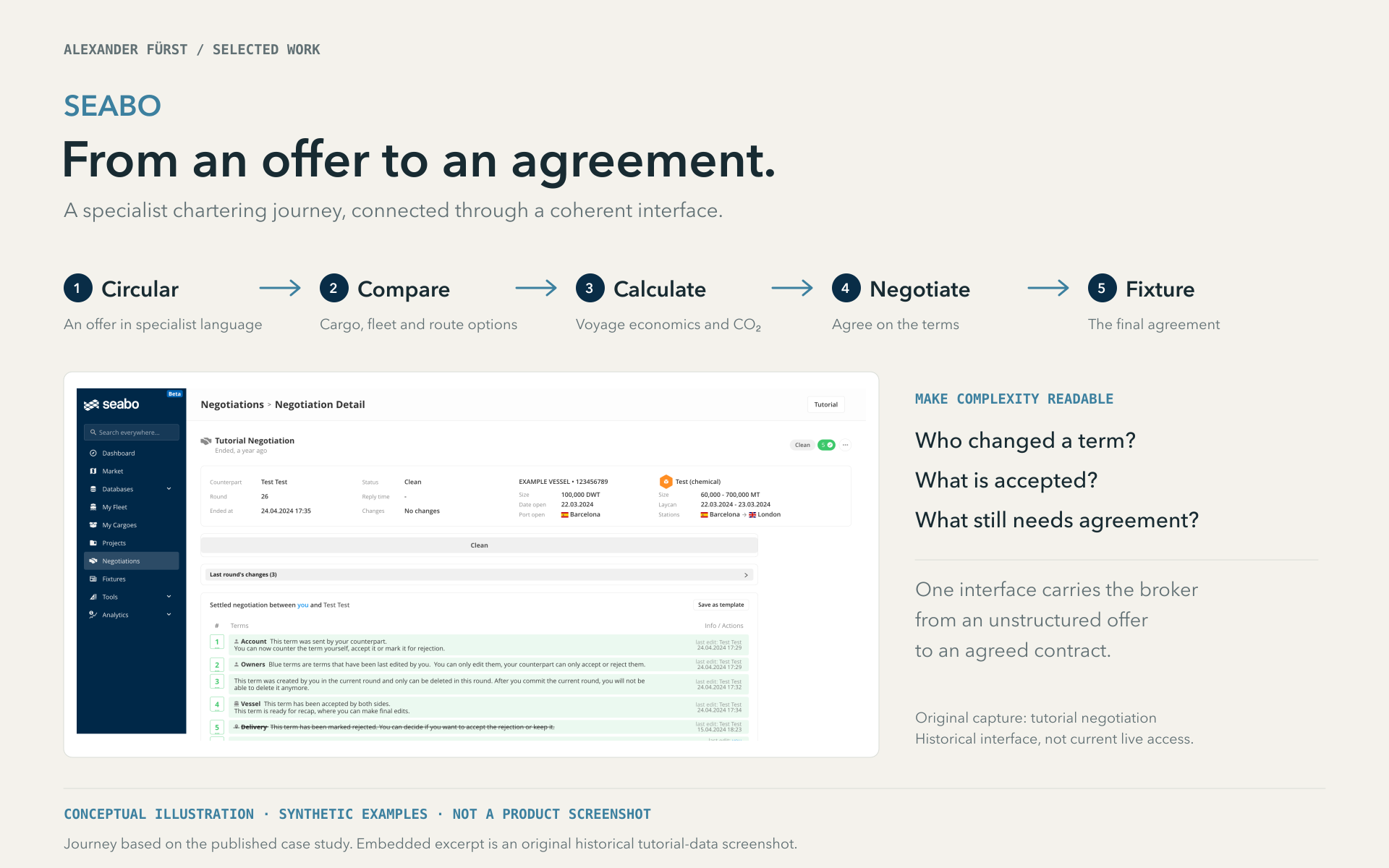
Automatically generated image description
This is an application screenshot of a negotiation interface from the Seabo platform, showing a detailed negotiation process. The interface has a dark blue vertical sidebar on the left with menu options like Dashboard, Market, Databases, My Fleet, My Cargoes, Projects, Negotiations, Fixtures, Tools, and Analytics. The main panel displays a 'Negotiations - Negotiation Detail' screen with negotiation metadata at the top and a list of last round's changes below, color-coded in green and yellow. The page uses a clean, light background with blue and black text, and includes instructional text and navigation steps above the screenshot.
Making operational data actionable
My work also extended into controlling and analysis, combining the platform’s circulars, projects and fixtures with AIS-based geographic information. This included actionable congestion warnings at shipping chokepoints such as Gibraltar and Suez. The challenge was to turn a large amount of data into a useful next decision.
Across the engagement, more than 50 inherited usability issues were addressed and seven journeys were created or substantially reworked. Seabo served several enterprise customers. My contribution combined a broad redesign with continuous delivery inside a running product; my engagement ended in July 2026.