
Case study
RoadTrippin – Collaborative Road Trip Planner
Last updated:
One place for a trip, from the first idea to the last meal.
I think visually, but planning a trip meant scattering information across documents, spreadsheets, booking sites, airlines, notes, email, Pinterest, Instagram and blogs. RoadTrippin began as my answer to that fragmentation: a map-centred place to plan a journey and use it while travelling.
Building around real journeys
I designed and built the application as a solo project in evenings and weekends. Each trip gives me a reason to extend it. Routes, places, itinerary details and collaborative planning come together around the map, so the plan stays connected to the geography instead of becoming another disconnected document.
Planning together, in the same place
Live collaboration was a core reason for building RoadTrippin. I wanted friends to see and work on the same map and itinerary while chatting or on a call, and to use the same plan across several devices at once. Endless chat histories had scattered ideas, changes and practical details across separate conversations. Keeping them in one shared plan means everyone can see the changes as they happen, instead of reconstructing the latest version from messages.
Planning with an assistant in context
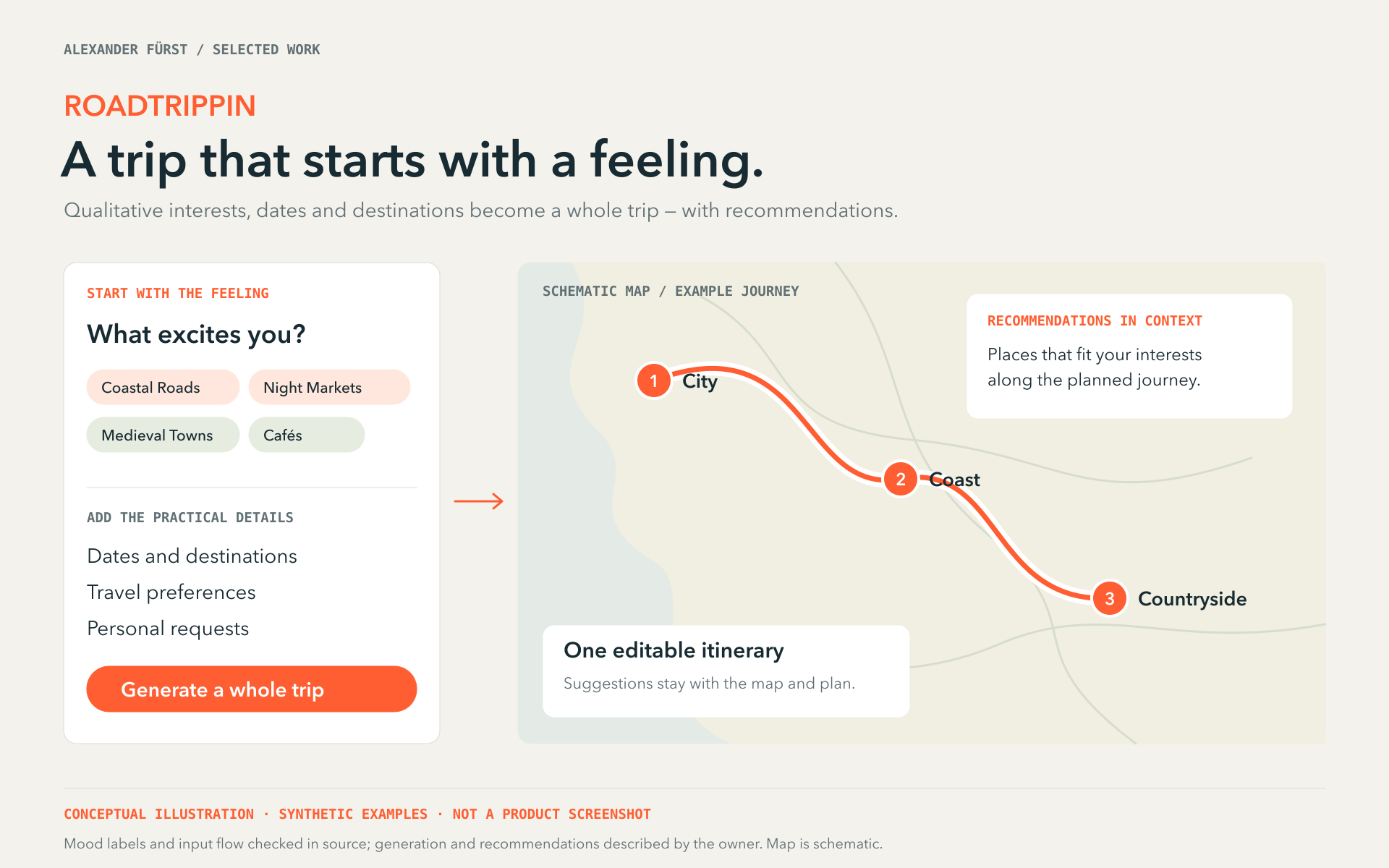
The AI assistant can draft whole trips and day trips around a desired travel profile, suggest places along a route, find restaurants in a city or propose a worthwhile break during a long drive. It supplies the details inside the same application where I organise and customise the journey, keeping suggestions connected to the map and itinerary.
Automatically generated image description
This conceptual diagram titled 'ROADTRIPPIN' illustrates a trip planning interface focused on qualitative interests and practical details. On the left, a white panel prompts users to select what excites them with options like Coastal Roads, Night Markets, Medieval Towns, and Cafés, followed by sections for dates, travel preferences, and personal requests. A prominent orange button labeled 'Generate a whole trip' is below. To the right, a schematic map shows a journey with three numbered stops: City, Coast, and Countryside, connected by an orange line. Text boxes explain editable itineraries and contextual recommendations. The background is light beige with minimalistic design.
The product grows from my own use before and during travel. That close feedback loop makes the practical details matter: an idea needs to remain useful once the journey is underway, and a shared itinerary needs to support the people travelling together.
A food atlas that becomes a personal diary
As a food enthusiast, I recently added a journal for local dishes and regional must-tries. It combines discovery with a checklist, personal reviews and a record of what I have tasted along the journey. Those entries also build a preference profile for later recommendations. RoadTrippin remains an evolving personal travel tool, with each new journey shaping what I build next.