
Case study
mem0.one – Agent Memory Management
Last updated:
Giving AI conversations a memory that can connect and change.
mem0.one began with the idea of giving AI agents a memory that learns and “thinks” like a human brain. Building on a fork of mem0 v4, I added a graph layer for my own AI workflows. I wanted memory to hold more than isolated facts: it should connect experiences, reflect their emotional and temporal context, and revise those connections as new information arrives.
Building on an existing foundation
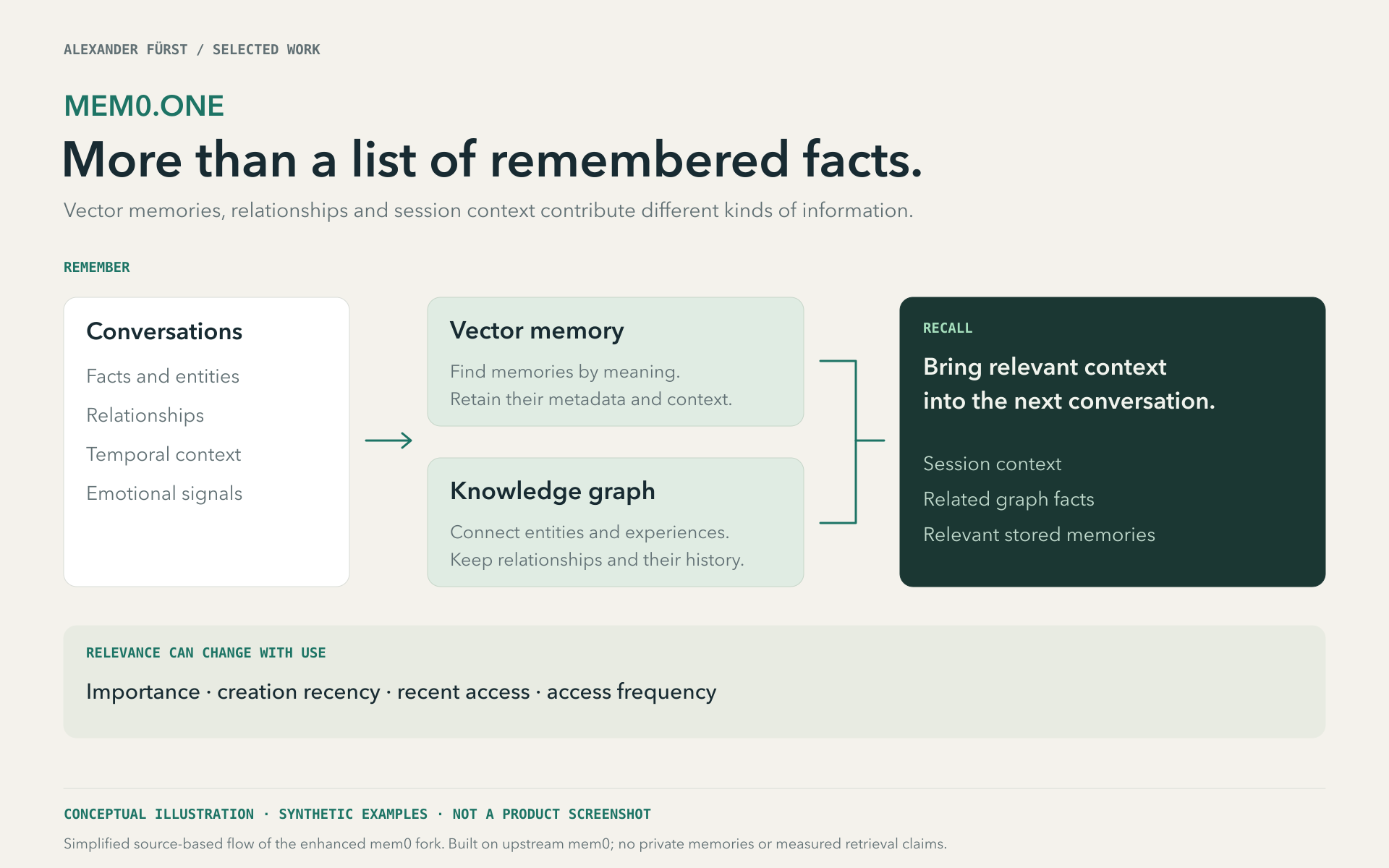
My contribution is the additional graph and retrieval behaviour, alongside its visual representation. Temporal, emotional and relational information adds context to memories, while weights and amendment histories help represent their relevance and evolution. The upstream mem0 project remains the foundation of the system.
Automatically generated image description
This is a conceptual diagram illustrating the MEM0.ONE system for managing memories and context in conversations. The layout uses a clean, minimal design with a light beige background and dark green text. It is divided into sections: 'Conversations' on the left lists elements like facts, relationships, temporal context, and emotional signals. Arrows point to two central boxes labeled 'Vector memory' and 'Knowledge graph,' describing their functions. On the right, a dark green box titled 'Recall' explains bringing relevant context into conversations. Additional notes on relevance and disclaimers appear at the bottom.
A continuously revised network
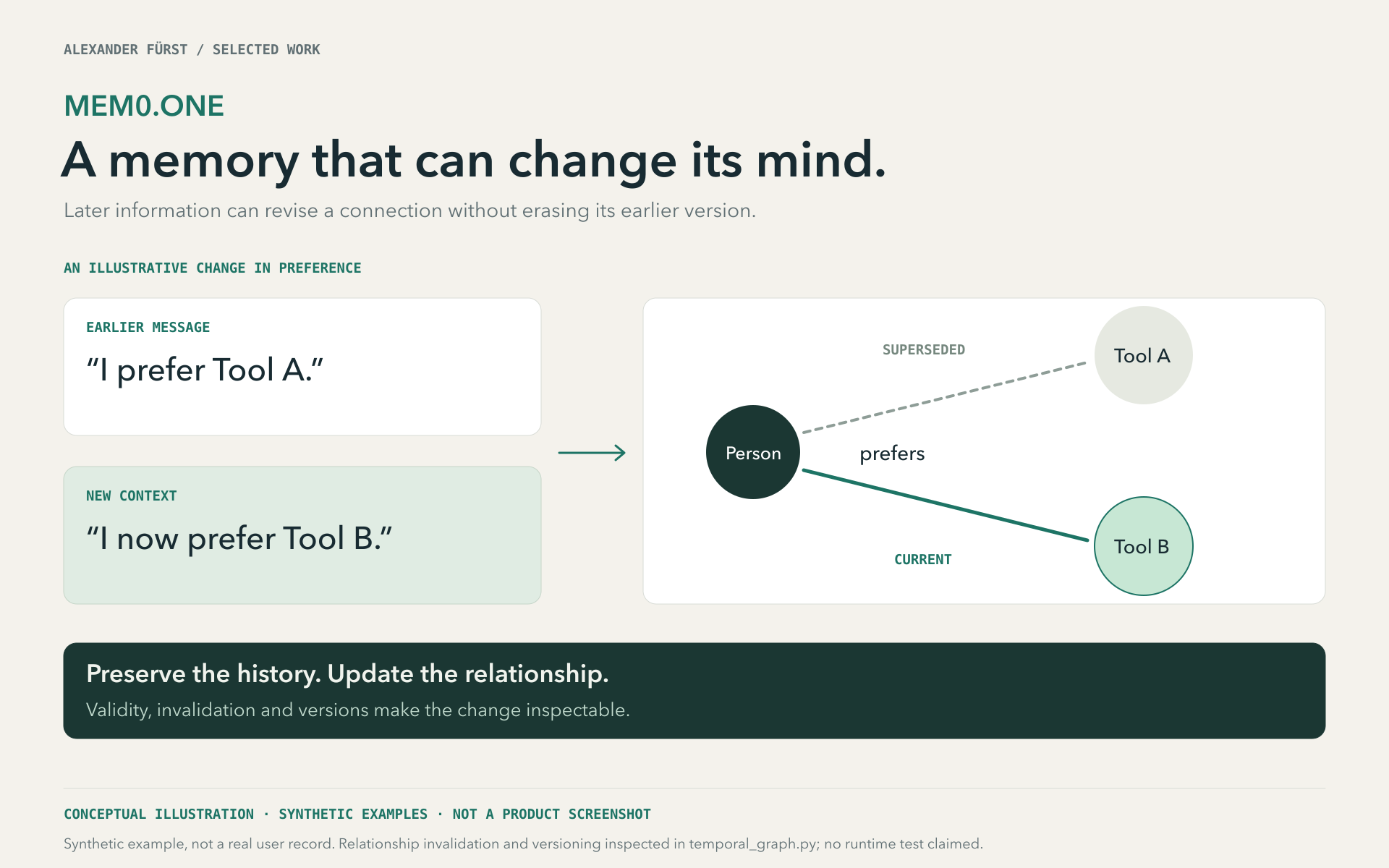
I feed messages from my local AI applications into the system so it can keep creating connections and correcting them as new context arrives. A memory needs to be able to change: later information may refine an earlier statement or reveal a different relationship. The retrieval flow brings these signals together when deciding what context to return.
Automatically generated image description
This is a conceptual diagram and text-based illustration explaining a memory model called MEM0.ONE that allows updating preferences without erasing earlier versions. The layout includes a heading, subheading, and two text boxes showing an earlier message 'I prefer Tool A.' and a new context 'I now prefer Tool B.' To the right, a simple graph shows a 'Person' node connected by a solid line labeled 'prefers' to 'Tool B' (current) and a dashed line to 'Tool A' (superseded). A dark banner below emphasizes preserving history and updating relationships.
The practical goal is to give my AI tools richer context across conversations. Keeping relationships and their revisions visible also makes it easier for me to understand how the memory has developed through use.
Seeing the connections
I also built the visual representation out of curiosity: I wanted to see how my “brain” is connected. It makes the graph something I can explore, alongside using it for retrieval. Developed in evenings and weekends, mem0.one runs in my personal AI workflow and receives ongoing additions and corrections through that use.