
Case study
Glyphstone — Interactive Glyph Display
Generative art, played by touch.
Glyphstone turns the generative ASCII animation from my Fuerst.one homepage into a small, standalone object you can shape with your fingers. Soldered GPIO pin headers emerge through the enclosure and become touch and gesture controls for the animation. The working prototype combines an ESP32-powered display, a custom 4 × 7 pixel typeface, plasma and cellular animations, and a parametric 3D-printed enclosure.
From a browser animation to an object
The starting point was a living field of characters on a website. Bringing it onto a small display meant rethinking its scale, composition, contrast and controls. A compact object needs to remain legible at a glance and useful without a keyboard, mouse or browser.
I developed the concept, interaction design, firmware and enclosure as a solo project. The board’s buttons handle brightness, power and mode changes; the enclosure brings the display and its touch controls together in a small standing object.
Turning GPIO pins into an instrument
The distinctive interaction comes from repurposing the board’s GPIO connections. Soldered pin headers pass through the case and form two control rails: touching them and sliding a finger along them changes the animation continuously.
In plasma mode, the right rail controls zoom, tightening or spreading the interference pattern. The left rail stirs the field, increasing its chaos and speed. Zoom stays where you leave it; the agitation eases away when you release the left rail.
The firmware combines the ESP32’s capacitive touch sensing with analog signal changes on pins without dedicated touch support. Calibration interprets the response across neighbouring pins as a continuous position. In the cellular animations, the same rails blend between presets and change the simulation’s vitality.
A typeface for a very small screen
The original T-Display has a 135 × 240 pixel panel. Standard embedded fonts were too wide, too small or left too few characters on screen. A custom condensed 4 × 7 pixel typeface creates room for a dense field of glyphs while keeping the central label readable. The same glyph artwork feeds the firmware font and the display-preview tooling.
Firmware that can be explored away from the board
The animation and other portable libraries are separated from the display hardware. Compile-time board profiles support different ESP32 display boards, while a native emulator and preview tools make it possible to explore visuals and controls on a desktop. Golden-reference test fixtures compare the C++ plasma with frames generated from the original web implementation.
Designing around real components
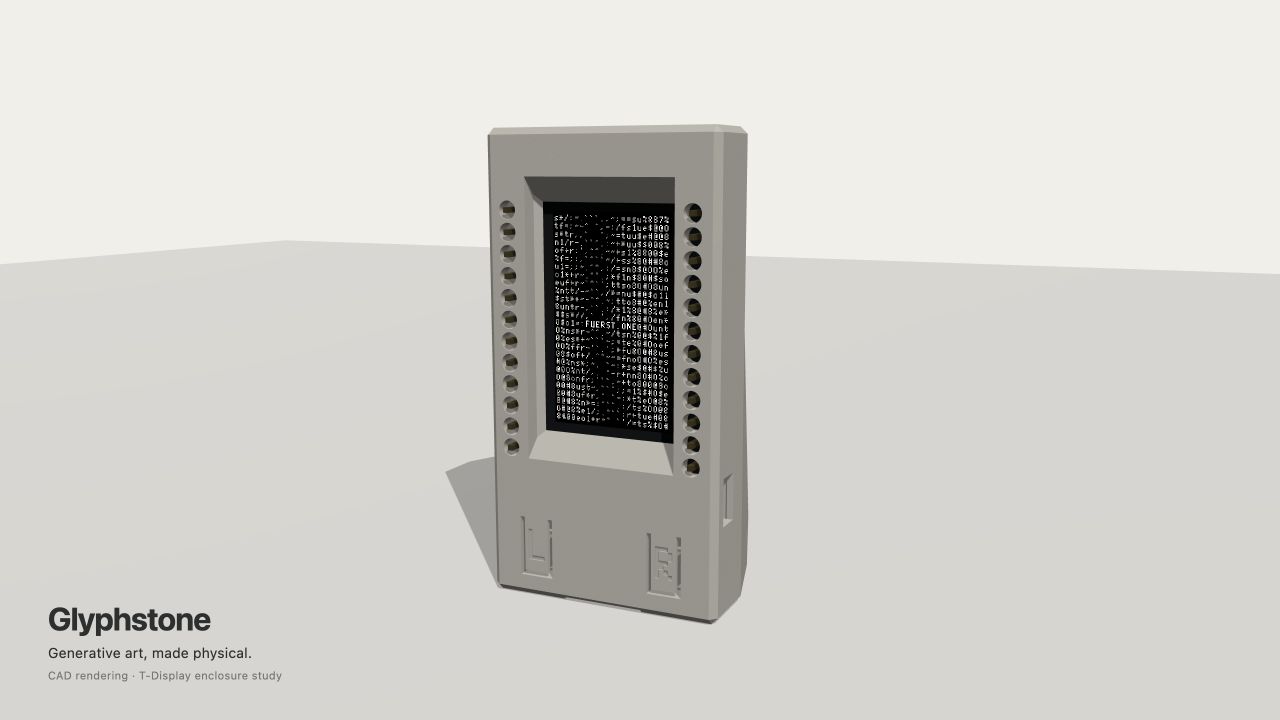
The enclosure is a parametric build123d model, developed around the T-Display board and battery. Multiple front and back variants explore display framing, header access, buttons and the standing angle. The CAD workflow includes geometry checks and a browser viewer for inspecting components and variants.
The renderings show existing T-Display enclosure geometry with a firmware-library-generated screen preview. The assembled image uses the flush front and flat-foot back variant; it is a design visualization, not a photograph of the confirmed physical assembly. The exploded image separates parts for illustration and does not prescribe an assembly sequence.
Result and scope
This personal project brings visual identity, custom typography, embedded interaction and enclosure design together in a single object. I completed the prototype over roughly a month, working mainly in the evenings and on weekends. Repository milestones document the implementation in August 2026.
Related project: Fuerst.one ASCII Plasma.